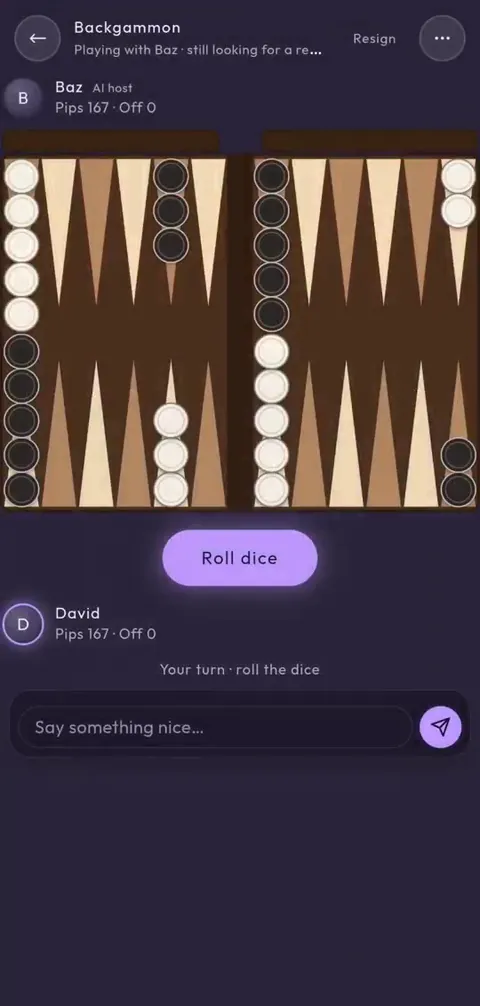
The goal
Each player has 15 checkers. You move them all the way around the board into your home board and then take them off the board (that’s called bearing off). The first player to bear off all 15 checkers wins.
The board
The board has 24 narrow triangles called points, in four quarters of six. Your home board is the quarter where your checkers end up. You and your opponent move in opposite directions.
At the start, each player has 2 checkers on the 24-point, 5 on the 13-point, 3 on the 8-point and 5 on the 6-point (counted from your own side).
Moving
- Each player rolls one die to start; the higher number goes first and uses both dice.
- Then you roll two dice on your turn. Each die is one move: with a 5 and a 3 you move one checker 5 points and one checker 3 points, or one checker 8 points.
- A double (for example 4 and 4) means you play that number four times.
- You must use both dice if you can. If you can only use one, you must use the bigger number if possible.
Blocked points, blots and hitting
You can’t land on a point that has two or more of your opponent’s checkers. A point with only one checker is called a blot. If you land on your opponent’s blot, you hit it: that checker goes to the bar in the middle.
A checker on the bar has to come back in first, through your opponent’s home board. Until it does, you can’t move anything else.
Bearing off and winning
Once all 15 of your checkers are in your home board, you start bearing them off with your rolls. The first player to bear off all 15 wins.
- A normal win counts 1 point.
- A gammon counts 2: your opponent hasn’t borne off a single checker.
- A backgammon counts 3: your opponent hasn’t borne off any checker and still has one on the bar or in your home board.
Three tips for your first games
Don’t leave blots where your opponent can easily hit them. Try to build two points in a row to block your opponent. And don’t race home too early: sometimes waiting is the stronger move.
The board on Bazdate only allows legal moves, so you can’t get it wrong. Practise against the computer, then play backgammon against a real person. Start a game now.